📌 Key Highlights & Summary
- 🧬 Biological mechanics of L, M, and S retinal cone photopigments
- 🧪 Farnsworth-Munsell 100 hue test principles behind our Hue Sort game
- 🎨 Palettes that remain distinct under red-green and blue-yellow dichromacy
Over 300 million people worldwide experience Color Vision Deficiency (CVD). Among populations of Northern European descent, roughly 1 in 12 men (8%) and 1 in 200 women (0.5%) have some form of red-green deficiency. Understanding how optical cone photopigments process spectral wavelengths is vital for constructing inclusive interfaces.
The Three Photoreceptor Cones
Human trichromatic vision relies on three varieties of cone cells in the retina:
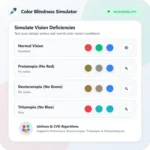
- L-Cones (Long Wavelength): Peak sensitivity around 560nm (Red). Deficiency causes Protanopia.
- M-Cones (Medium Wavelength): Peak sensitivity around 530nm (Green). Deficiency causes Deuteranopia (most common).
- S-Cones (Short Wavelength): Peak sensitivity around 420nm (Blue). Deficiency causes Tritanopia (rare).
Never Rely on Color Alone for Status Cues
When presenting crucial system states (success, warning, error), never use color alone. Always pair color cues with distinctive iconography (e.g. checkmarks ✓, warning triangles ⚠️, error crosses ❌) and descriptive text labels. Test your color discernment skills daily with our free Color Blind Test puzzle.